


 Shop Store
Monthly Archives: August 2026
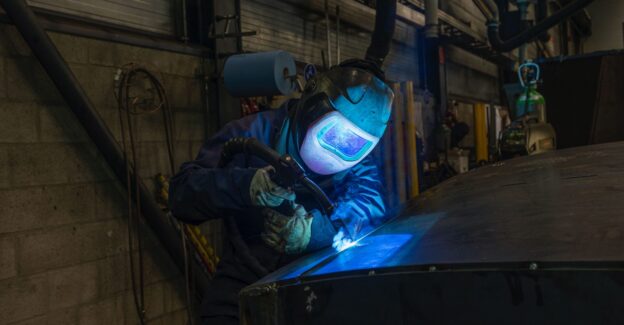
Best Welder for Car Restoration
If you do car restoration, you’ll eventually need welding done to repair or reassemble your vehicle. Rather than pay for professional welding labor, you may be better off buying your own welder and doing it yourself. But with so many options available, what’s the best welder for car restoration? The Motor Bookstore examines the possibilities.
Gas (torch) welders
These oxy-acetylene torches are the stereotypical welder. Although these machines have the ability to cut metal and do quick work, they have too many drawbacks to use as a car restoration welder. Among other things, they’re unwieldy, have a steep learning curve, are expensive, require numerous safety precautions, and tend to warp metal.
MIG (Metal Inert Gas) welders
These Arc welders use a spool of welding wire fed through a tube that also contains the shielding gas. MIG welders have a number of advantages, especially for beginners. They’re the easiest welding type to learn, fast, work on most common metals, can weld thin metals, and are relatively inexpensive. On the other hand, they aren’t very portable and don’t work well for outdoor welding, while the costs of shielding gases and electrodes add up.
Stick welders
This is another Arc welder that uses a consumable flux-coated electrode, which contains the specific metal for the weld being performed. You can use these welders in any position and in wind or humidity. They are less sensitive to metal cleanliness and are the least expensive option. However, they aren’t good for thin metals, require lots of practice to learn, and can leave spatter.
TIG (Tungsten Inert Gas) welders
TIG welders use a non-consumable tungsten electrode and shielding gas. They give a high-quality and cosmetically attractive weld with no spatter, can weld most metals including aluminum, and work well with thin metals. The heat density can even be adjusted with a hand or foot control. The disadvantages are that TIG welders are slow, require a water supply for cooling, take a lot of time to learn, and can be expensive.
The verdict
For beginning welders or those on a budget, MIG welders offer the best combination of quality and affordability for car restoration. If you’re an experienced welder and expect to be doing lots of it, the investment for a good TIG welder will be worthwhile.
Found the right welder but not sure how to start? Pair it with great books like Weld Like a Pro and The Haynes Welding Manual to become a welding expert!
Is this your first big restoration? Check out our Car Restoration 101 blog before you get started!


Search Our Blog